Menopause
Irregular periods can be difficult to define; what is irregular for one woman can be regular for another. Nonetheless, irregular periods can be worrying, particularly if it's the first time your menstrual cycle is irregular. How do you know when you should be alarmed by your symptoms, or if the irregularity can be corrected?
How Do I Know if I Am Having Irregular Periods?
Irregular periods are different for each person. A regular cycle is occurs every 24-35 days with a bleeding period that typically lasts between 3 and 7 days. The menstrual cycle varies between women depending on her hormones. To help determine whether your period is irregular and if your cycle has become abnormal, calculate how long your menstrual cycle usually lasts.
Irregular periods are usually defined as being too frequent or infrequent, (less than 21 days or more than 35 between them) but you may also experience a change in the duration (either less than 2 days or more than 8) and flow (unusually heavy or light).
Why Am I Having Irregular Periods?
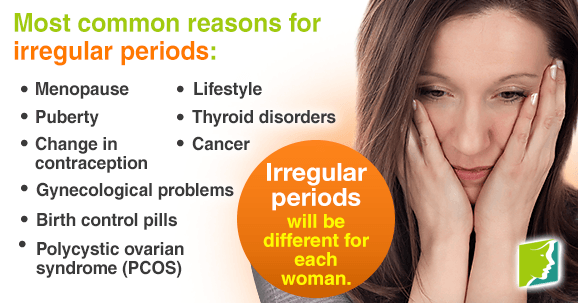
There are many reasons why you could be having irregular periods, such as:
Menopause. Perimenopause, the period leading up to menopause, is characterized by severely fluctuating hormones which can lead to irregular periods.
Puberty. It can take several years after puberty to develop regular menstrual pattern. Irregular periods are quite common.
Change in contraception. If you have changed from one hormonal birth control to another, or have changed from a non-hormonal birth control method to a hormonal one, your menstrual cycle may be affected.
Choice of contraceptive. Birth control pills and hormonal birth control methods can alter your hormones levels. Your body may need time to adjust to the new hormones, or prepare to stop your periods. Bleeding can become more erratic, lighter, or heavier depending on the contraceptive.
Lifestyle. A poor diet, stress, heavy exercise, and an extreme change in weight can alter your hormone levels and cause irregular bleeding.
Polycystic ovarian syndrome (PCOS). A woman suffering from PCOS may find that ovulation doesn't usually take place, so bleeding can become irregular or stop completely.
- Gynecological problems. Unexpected pregnancy, early miscarriage, and problems with the womb all can cause irregular periods.
Thyroid disorders. Irregular bleeding could be a sign of an imbalance in your thyroid hormone.
Cancer. Heavy bleeding between periods can be a symptom of cervical cancer, but this is extremely rare.
Should I Worry?
In most cases, there is no need to be concerned about your irregular periods. In fact, 90% of women have experienced irregularities in their menstrual cycle before starting perimenopause. If you are concerned, you should visit your doctor to determine the cause and the best treatment.
Is There Anything I Can Do to Manage My Irregular Periods?
Treating your irregular periods depends on their cause and how long you've been experiencing them. If you are still in puberty or just past, it's usually advised that you leave them untreated, as your body just needs time rebalance the hormones and adjust to the changes. The same can be said if you are going through menopause. If you have irregular periods because of an underlying condition, you should seek medical help.
More Information about Irregular Periods
Despite being common, irregular periods can be concerning when you're not certain of the cause.
Sources
- Hutchinson, Susan M.D. "The Stages of a Woman's Life: Menstruation, Pregnancy, Nursing, Perimenopause, Menopause". November 2007.
- Love, Susan M.D. Menopause and Hormone Book. New York: Three Rivers Press, 2003.
- BMJ Group. "Menopause: What is it?" Patient Leaflet. 2007
- National Health Service UK. (n.d). Irregular Periods. Retrieved August 3, 2015 from http://www.nhs.uk/conditions/Periods-irregular/Pages/Introduction.aspx