Menopause
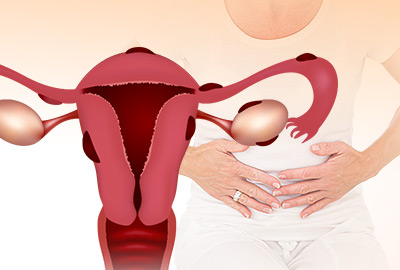
Periods and the time leading up to menstruation are often associated with pain and cramping. Although the menstrual cycle is a normal and natural part of a woman's life and health, women should not have to live through excruciating pain and cramping every month. There are steps that can be taken to soothe period pain and cramps. It is also important to recognize the signs of an underlying medical condition that could be causing painful or irregular periods.
About Painful Irregular Periods
Pain and cramps during and before menstruation is scientifically called dysmenorrhea. Menstrual cramps are caused by contractions that the uterus makes to help its lining, called the endometrium, shed and leave the body in the form of menstrual fluid. Certain chemicals produced by the body trigger these contractions. These chemicals are called prostaglandins, and higher levels of them are associated with more severe menstrual cramps.
Underlying Conditions That Cause Menstrual Pain
Menstrual pains and cramps can also be a symptom of underlying medical conditions, such as:
Polycystic ovarian syndrome (PCOS). In this condition, the ovaries become enlarged, and fluid-filled sacs grow on the ovaries. Symptoms include missed periods, acne, and raised levels of male hormones.
Endometriosis. Parts of the uterus's lining attach to other parts of the reproductive system instead of shedding with the menstrual fluid. This condition causes irregular and painful menstruation.
Fibroids. Fibroids are noncancerous tumors that grow in and around the uterus. Fibroids can cause menstrual pain and irregular bleeding.
If your symptoms match those caused by an underlying medical condition, it is important to seek medical attention. A doctor will be able to perform different exams and should talk to you in order to find the root cause of your pain and treat it.
Treating Painful Irregular Periods
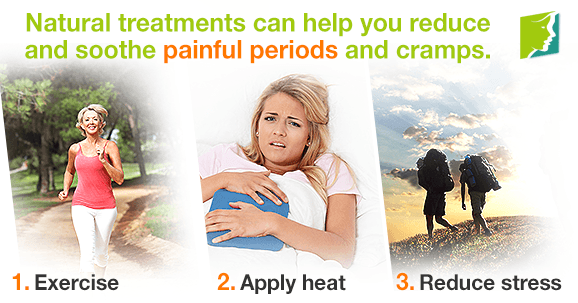
Lifestyle changes and treatments that do not involve medication can help reduce and soothe painful periods and cramps. These treatments include:
- Exercise. Exercising - even if it is just jogging around the local park, doing yoga, or walking the dog - can go great lengths to soothe menstrual pain.
- Apply heat. This can be in the form of a hot compress placed on the abdomen or a hot bath.
- Reduce stress. Stress can aggravate menstrual pain and cramps, so finding ways to channel your stress - whether it is running, kickboxing, drawing, journaling, or something else - can go a long way in easing menstrual pain.
Medications that can treat menstrual cramps and pain include:
Over-the-counter painkillers or stronger painkillers available by prescription
Hormonal birth control prevents ovulation and therefore reduces some menstrual cramps and pain
Natural medicines, such as chasteberry, have also been found to have some application
Click on the following link for more treatment options for irregular periods.
Sources
- Mayo Clinic Staff. (2014). Menstrual Cramps. Retrieved October 6, 2015, from http://www.mayoclinic.org/diseases-conditions/menstrual-cramps/basics/definition/con-20025447
- National Health Service UK. (2015). Painful periods (dysmenorrhoea). Retrieved October 6, 2015, from http://www.nhs.uk/conditions/Periods-painful/Pages/Introduction.aspx
- National Institutes of Health. (2014). Painful Menstrual Periods. Retrieved October 6, 2015, from https://www.nlm.nih.gov/medlineplus/ency/article/003150.htm