Menopause
A normal period lasts anywhere between 3 and 7 days, but that doesn't mean that women have periods that can last longer than normal. Long menstrual periods can be uncomfortable and painful to deal with.
What Are Irregular Periods?
Irregular periods are common after pregnancy, while breastfeeding, if taking hormonal birth control, or when approaching menopause. It is also common for young women who first get their period to experience irregular periods as their bodies grow and hormone levels change. If you have been bleeding for more than one week it is suggested that you see your doctor, since constant blood loss can result in iron-deficiency anemia.
Do I Have Long Menstrual Periods?
You know your body, and you can tell when something isn't right. If you normally have periods that last for four days and you have been having periods that last eight or nine days, then something might be wrong.
It is a good idea to keep track of your periods. Mark down on your calendar the first day of your last period until the first day of the next. To understand your cycle, keep track of your periods from month to month and take note of any spotting and pain if they occur. It can also be helpful to take note of whenever bleeding feels unusually heavy.
What Are the Causes of Long Menstrual Periods?
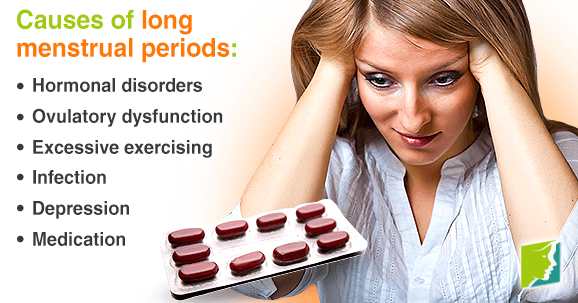
While there can be many contributing factors, here is a list of the causes of long menstrual periods:
Stress. Chronic worrying and tension can raise the body's cortisol levels and affect menstrual cycles.
Dietary problems. It's important to eat right, as the body needs proper nutrients to recover its balance.
Excessive exercising. Excessive exercising and a low body fat percentage can lead to irregular periods.
Illness or physiological imbalance.
Thyroid disorders. Hypothyroidism is a common cause for heavier and longer periods, while the opposite disorde - hyperthyroidism - often causes missed periods.
Medications. Both prescription medication and recreational drugs can induce irregularities.
Treatment for Long Menstrual Periods
As mentioned above, stress, fatigue, and anxiety can cause long menstrual periods. If you are experiencing them for the first time consult your medical professional. Your doctor can run blood tests to check your hormonal levels and rule out thyroid conditions or polycystic ovarian syndrome (PCOS).
Also, exercise is very important for balancing hormone levels. Regular cardiovascular activity is very useful to lower stress levels, which may be behind irregular periods. However, excessive or compulsive exercising could have the opposite effect.
Alternative medicines have also been known to help people with long menstrual periods. Women have found relief using aromatherapy, acupuncture, and herbal supplements. Click on the following link for more information on treatment for long irregular periods.
Sources
- Hutchinson, Susan M.D. "The Stages of a Woman's Life: Menstruation, Pregnancy, Nursing, Perimenopause, Menopause". November 2007.
- Love, Susan M.D. Menopause and Hormone Book. New York: Three Rivers Press, 2003.
- BMJ Group. "Menopause: What is it?" Patient Leaflet. 2007