Menopause
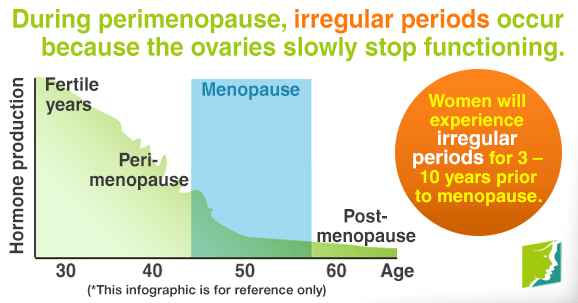
Irregular periods are often one of the first indications that a woman is approaching menopause. Although the exact symptoms of irregular periods depend on each woman's unique menstrual cycle, nearly all menopausal women will experience irregular periods for around 3 - 10 years prior to menopause. In fact, only 10% of women reach menopause without having experienced irregular periods.
What Causes Irregular Periods?
Irregular periods typically occur during perimenopause, the stage preceding menopause. During this time, hormone production decreases and the ovaries become decreasingly inefficient. The closer a woman gets to menopause, the more she will be affected by imbalanced hormones.
When Does Menopause Begin?
Quick Fact
A woman has reached menopause after she has gone 12 consecutive months without a period.On average, menopause begins at the age of 51, but irregular periods can be experienced by women who are in their mid-40s or even their late 30s. Symptoms of irregular periods vary from woman to woman, but almost all experience changes to their cycle.
While irregular periods can be bothersome, it's important to remember that they are a natural part of a woman's transition to infertility.
What Is a "Normal" Period?
While every woman's menstrual pattern is different, understanding what your "normal" period cycle is like is valuable, as this allows you to appreciate any irregularities. Commonly, however, a menstrual cycle lasts between 21 and 35 days, with menstruation occurring between day 3 and 7. The average amount of blood loss ranges between two and eight tablespoons. It's important to note, however, that this description is somewhat general, and each woman's experience is likely to vary.
Any changes to a woman's menstrual cycle that persist for several months and involve abnormal bleeding or unusual cycle lengths are defined as irregular periods.
Specific symptoms that can help to determine whether or not you are experiencing irregular periods include:
- Infrequent or too frequent periods
- Missed periods
- Painful cramping
- Extended bleeding
- Changes in blood flow
- Blood clots
Consult your doctor if you think you are experiencing irregular periods. Annual Pap smears and pelvic examinations are good opportunities to mention your concerns.
If you experience any of the following symptoms, contact your doctor immediately.
- Heavy bleeding
- Extended bleeding (more than seven days)
- Bleeding after sex
- Spotting
- Abdominal pain
- Excessive hair growth
- Unexplained weight gain
- Any odorous discharge
Click on the link below to learn more about irregular periods and the various treatments available.
Sources
- Hutchinson, Susan M.D. "The Stages of a Woman's Life: Menstruation, Pregnancy, Nursing, Perimenopause, Menopause". November 2007.
- Love, Susan M.D. Menopause and Hormone Book. New York: Three Rivers Press, 2003.
- BMJ Group. "Menopause: What is it?" Patient Leaflet. 2007