Menopause
While having irregular periods can be a sign of infertility, it doesn't mean that every woman with abnormal menstrual cycles is unable to get pregnant. If you have irregular periods, you and your partner may face more obstacles than the average couple, but learning about these challenges can help you find the appropriate treatment.
Find out if you can get pregnant with irregular periods and how to do so to go forth with the knowledge you need concerning your reproductive health.
When Is My Period Considered Irregular?
While there is no “normal” schedule for menstrual cycles, most women's cycles are between 21 and 35 days long. Every woman has at least a couple of irregular periods during her reproductive years, especially during early adolescence and before menopause.
A few main types of irregular periods are the following:
- Anovulatory cycles are characterized by menstrual bleeding without ovulation, which means no egg is released and, therefore, conception is not possible.
- Oligoovulation is when ovulation occurs on an irregular basis.
- Amenorrhea occurs when periods have stopped coming completely for at least 90 days.
- Menorrhagia means heavy menstrual bleeding.
- Polymenorrhea happens when periods come more frequently than 21 days.
- Oligomenorrhea is when menstrual bleeding lasts for fewer than two days, or with very scant bleeding.
- Dysmennorhea refers to painful periods and severe menstrual cramps.
- Spotting is minor bleeding occurring between periods, often right after ovulation.
Generally, there are underlying medical conditions behind these abnormalities, thus making getting pregnant with irregular periods much more difficult, if not impossible. Until the underlying cause is treated, conception might be close to nil.
How Does Menstrual Irregularity Affect My Ability to Get Pregnant?
It is essential to plan conception around a woman's ovulation, as these are the days in which she is fertile. This can be difficult for women with irregular periods.
If a woman is not menstruating regularly, chances are she is not ovulating regularly either. This means the ovaries are releasing eggs less frequently than what is typical, making it is difficult to judge when the fertile window will be. All of this uncertainty leads to fewer chances to conceive.
How Can I Overcome My Irregular Periods to Get Pregnant?
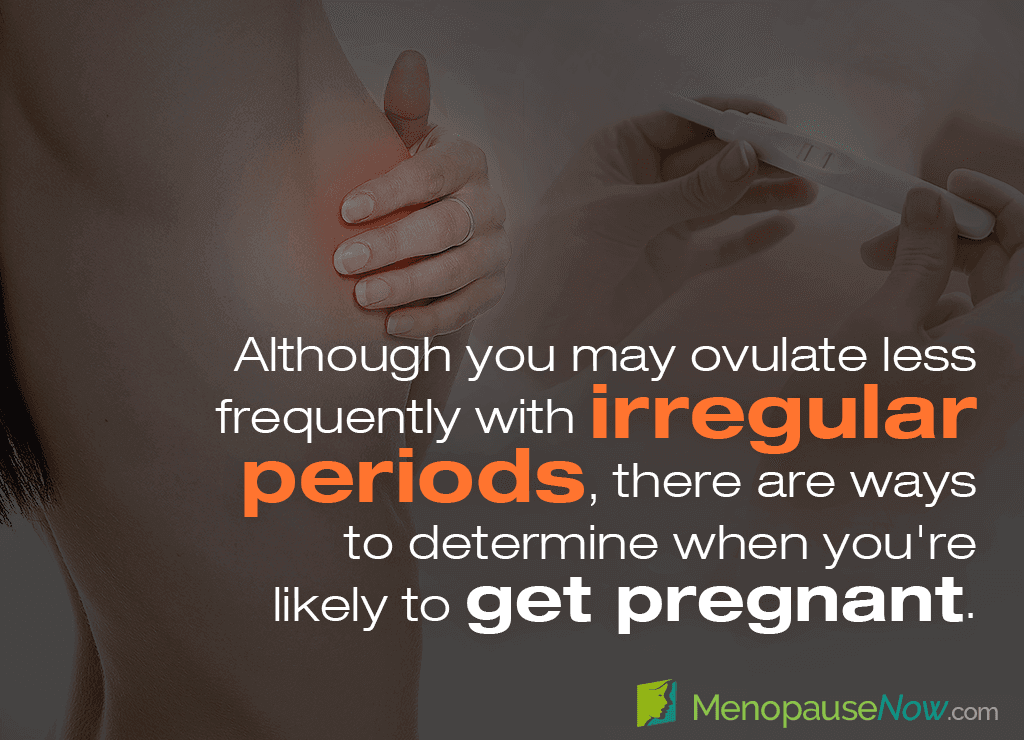
Although you may ovulate less frequently, there are ways to determine when you're likely to get pregnant. Since counting two weeks back from the start date of your projected period - to determine your fertile window - may not work, you can look for other signs of ovulation.
There are several ovulation tests women can use to gauge when they will be most fertile. These include checking cervical mucus for egg-white consistency; examining cervical position for one that is high, soft, and open; measuring a slight spike in basal body temperature; and more.
If monitoring these signs doesn't work, try an at-home ovulation test that detects the amount of luteinizing hormone (LH) your body produces, which increases just before you begin to ovulate.
Other symptoms of ovulation might include tender breasts, moodiness, and abdominal bloating, though not all women experience them.
Recommendation for Getting Pregnant with Irregular Periods
All in all, while irregular periods can make a woman's path to a happy, healthy motherhood challenging, it is not impossible to conceive. You can get pregnant if you have irregular periods by taking the appropriate measures to treat the underlying cause of the abnormalities.
Read further information on natural and effective irregular periods treatments that can serve women throughout all stages of life.
Sources
- Albers, J.R. et al. (2004). Abnormal Uterine Bleeding. American Family Physician, 69(8), 1915-1926. Retrieved March 28, 2019, from https://www.aafp.org/afp/2004/0415/p1915.html
- Better Health Channel. (2018). Ovulation. Retrieved March 28, 2019, from https://www.betterhealth.vic.gov.au/health/conditionsandtreatments/ovulation
- Cleveland Clinic. (2015). Abnormal Menstruation (Periods). Retrieved March 28, 2019, from https://my.clevelandclinic.org/health/diseases/14633-abnormal-menstruation-periods
- Medline Plus. (2018). Ovulation home test. Retrieved March 28, 2019, from https://medlineplus.gov/ency/article/007062.htm