Menopause
Hot flashes, characterized by sudden moments of intense heat, sweating, and increased heart rate, are an uncomfortable and frustrating symptom of menopause that three out of four menopausal women experience at some point. While there is no set hot flashes age, there is a period around which they generally start to occur.
Continue reading to learn more about how hot flashes and age are related for a better understanding of the interim period your body is going through.
Are Hot Flashes and Age Related?
Hot flashes generally start occurring in a woman's late 40s and early 50s. This is the time when she is going through the menopausal transition, also called perimenopause and commonly referred to as menopause. It is during this time that a woman can also start experiencing other menopause symptoms, such as irregular periods, vaginal dryness, low libido, and more.
Although hot flashes are most common during menopause, menopause is not the only time a woman can experience hot flashes. It is also possible for women to experience episodes during pregnancy, after giving birth (post-partum), and during the bleeding part of her menstrual cycle.
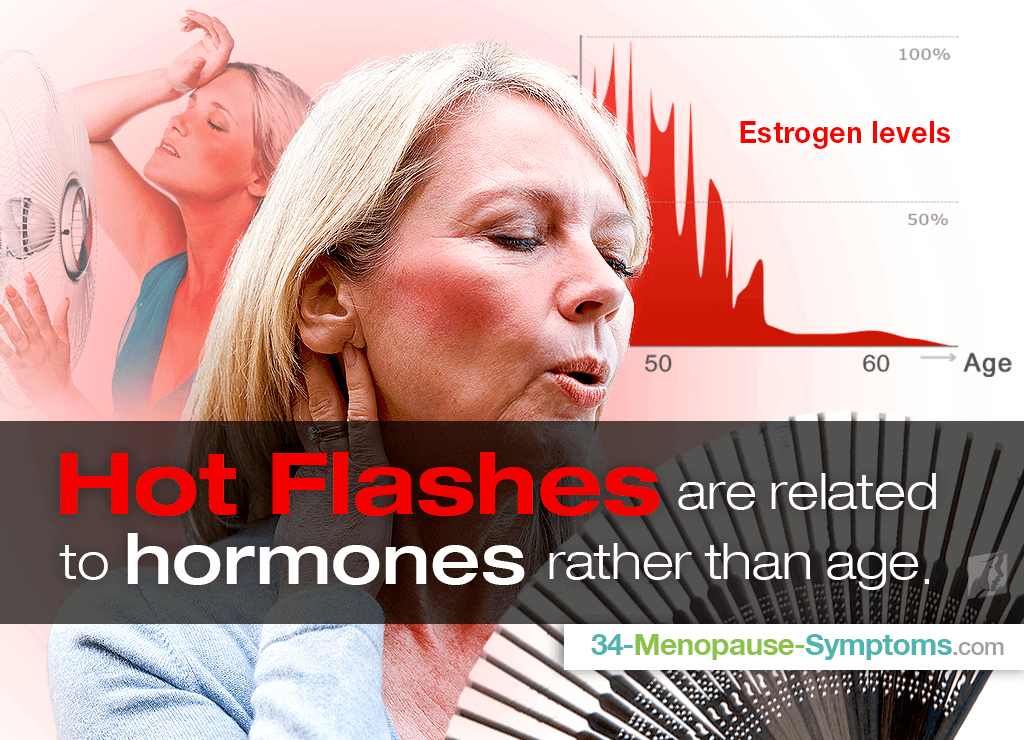
As a matter of fact, hot flashes are related to hormones rather than age. What causes hot flashes in old age - and any age at that - is when estrogen levels are under drastic fluctuation, throwing off bodily homeostasis. This variation causes the body to incorrectly believe it is overheating, thus provoking hot flashes.
Can I Have Hot Flashes After Age 65?
Whether you suffer from hot flashes into postmenopause depends upon when they began. Researchers found that women who had hot flashes before their menopause date suffered from the symptom for an average of nine to 10 years. On the other hand, those who suffer from hot flashes after menopause only had them for an average of three and a half years.
It is not common at this age except for women who experience late-onset menopause, which is defined as menopause after the age of 55. However, doing these calculations, it is possible for postmenopausal women to have hot flashes after age 65 and for postmenopausal women to even have hot flashes after age 70.
Can I Do Anything to Prevent Hot Flashes at Any Age?
Hot flashes cannot be entirely prevented, per se, but you can take action to manage hot flash episodes, lessen their frequency, and ultimately treat the underlying cause.
For instance, various self-help measures and lifestyle changes can be help ease hot flashes as they're occurring. These include dressing in layers; staying in air-conditioned areas; and avoiding triggers of caffeine, alcohol, spicy foods, and hot beverages.
Also, lessen their frequency by partaking in deep-breathing exercises and stress reduction techniques, such as mindfulness and meditation. Moreover, improve your diet to include phytoestrogenic foods, and exercise regularly to promote endocrine system health.
Nevertheless, the best method to relieve hot flashes is to treat the underlying cause of hormonal imbalance. Hot flash treatment can be pursued naturally with phytoestrogenic supplements, like black cohosh, or hormone-regulating supplements, such as Macafem. For those looking for pharmaceutical options, hormone replacement therapy (HRT) can be utilized. However, beware as its use has been linked to serious side effects.
Key Takeaways
Although hot flashes are more common with age as women progress into the menopausal transition, they can actually occur at any age as they are closely tied to hormone levels. Although not common, it is possible to suffer from hot flashes after age 65 and even to suffer from hot flashes after age 70 depending on when you officially entered menopause. While they can't be entirely prevented, there are several measures you can take to ease them, lessen their frequency, and treat the underlying cause of hormonal imbalance. Don't let this pesky symptom be a way of life. Talk to your doctor to see what works best for you.
Sources
- Harvard Health Publishing. (2015). Menopause-related hot flashes and night sweats can last for years. Retrieved October 4, 2018, from https://www.health.harvard.edu/blog/menopause-related-hot-flashes-night-sweats-can-last-years-201502237745
- National Institute on Aging. (2017). What is Menopause? Retrieved October 4, 2018, from https://www.nia.nih.gov/health/what-menopause