Menopause
Almost every woman going through menopause is searching for ways to help curb the irritating symptoms. Although it can be difficult to know which way to turn for help, there are various Chinese herbs for hot flashes that may help you battle the unbearable heat.
Continue reading to discover some Chinese herbs for hot flashes. Even though the knowledge of their ancient medicinal properties is as old as time, their effectiveness in helping menopausal women stay cool is what keeps them popular.
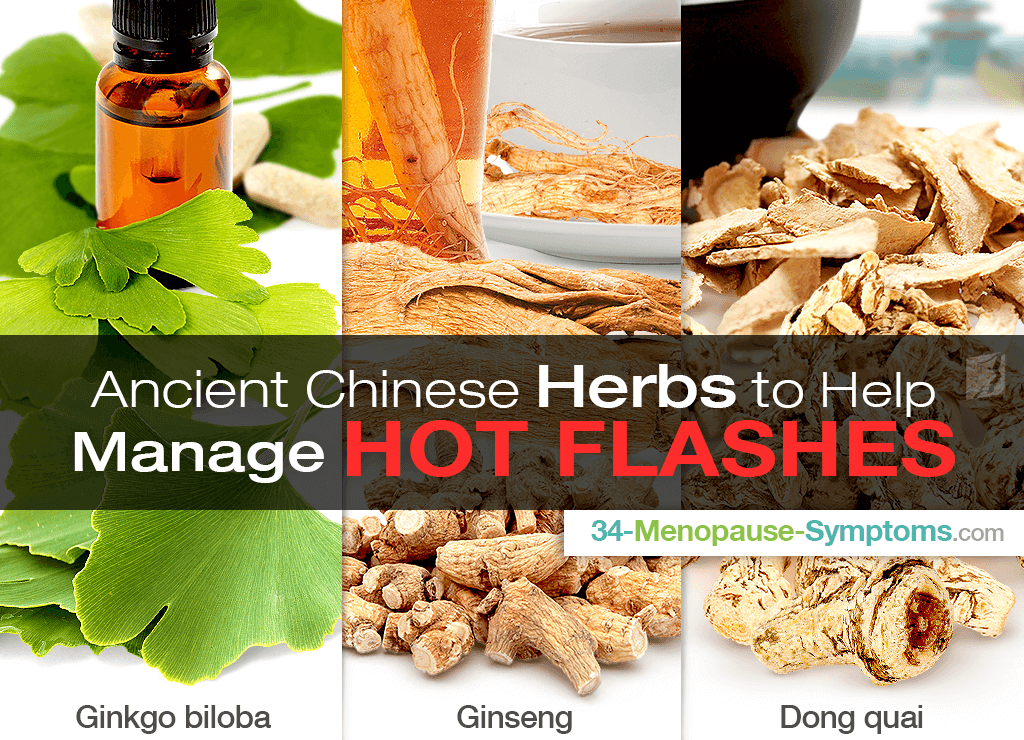
Ginkgo Biloba
Studies indicate that ancient Chinese culture used ginkgo tree seeds to eliminate cancer. Nowadays, ginkgo is prescribed in Europe and used by many people in the U.S., Canada, and across the world for its medicinal properties as an herbal treatment to promote mental clarity.
Aside from its ability to sharpen mental alertness, ginkgo biloba is known to have many positive effects on the human body: improvement of blood flow, protection against cell damage, and combating blood clots. It is also considered a Chinese medicine for battling hot flashes because of its effects on blood flow.
Ginseng
Ginseng possesses two key components necessary in fighting various menopause symptoms, including hot flashes: ginsenosides and phytoestrogens.
Ginseng's ginsenosides are adaptogens that can boost stamina and energy in humans and are capable of improving cognitive abilities. On the other hand, ginseng's phytoestrogens increase endogenous levels of estrogen by introducing plant-based hormones in the body, thus filling the hormonal gap at fault for causing menopausal hot flashes.
Dong Quai
Dong quai is a small perennial that is native to China and Japan. The herb's thick, brown roots have evolved to be known for their ability to treat an array of female ailments for thousands of years. It is praised for its uterine tonic effects, which include regulating the menstrual cycle and relieving menstrual cramps.
Additionally, in ancient China, the herb was used because of its phytoestrogenic properties that have the ability to stabilize reproductive hormone levels, similar to ginseng. When estrogen is stabilized, it is less likely that you will experience common symptoms of menopause, including hot flashes.
While ancient Chinese medicine for hot flashes could help you beat the heat temporarily, the best way to be rid of menopausal symptoms is to treat the underlying cause of hormonal imbalance. Learn more about natural hot flash treatments to get back to your daily routine without the extra sweat today.
Sources
- Gray, S.L. et al. (2004). Mycotoxins in root extracts of American and Asian ginseng bind estrogen receptors alpha and beta. Experimental Biology and Medicine, 229(6), 560-568. Retrieved November 5, 2018, from https://www.ncbi.nlm.nih.gov/pubmed/15169976
- Mashayekh, A. et al. (2011). Effects of Ginkgo biloba on cerebral blood flow assessed by quantitative MR perfusion imaging: a pilot study. Neuroadiology, 53(3), 185-191. doi: 10.1007/s00234-010-0790-6
- Oliynyk, S. & Oh, S. (2013). Actoprotective effect of ginseng: improving mental and physical performance. Journal of Ginseng Research, 37(2), 144-146. doi: 10.5142/jgr.2013.37.144
- Plants For A Future. (n.d.). Angelica sinensis - (Oliv.) Diels. Retrieved November 5, 2018, from https://pfaf.org/user/Plant.aspx?LatinName=Angelica+sinensis
- Zand, J. et al. (1999). Smart Medicine for Healthier Living. New York: Avery Publishing Group. Available from Google Books.