Menopause
Menopause is a natural transition that occurs in the female body causing the end of the menstrual cycle. Some women may experience complications with their reproductive systems which may cause early menopause. In other instances, menopause may be induced by surgery. Read on to learn more about menopause induced by surgery, the reasons for it, and advice on how to handle it.
Hysterectomy and Oophorectomy
Hysterectomies and oophorectomies are two of the most common procedures that can surgically induce menopause.
A hysterectomy is the removal of the uterus, though there are three different types, and they differ based on what parts of the reproductive system are removed. Some women only need their uterus and cervix removed, while others have their uterus, cervix as well as ovaries and fallopian tubes removed.
An oophorectomy is the removal of the ovaries. It's easy to see why many people confuse hysterectomies and oophorectomies as the territories are often blurred. Oophorectomies commonly surgically induce menopause because women no longer menstruate after their ovaries are removed, but may still menstruate if they had a hysterectomy.
Why Do Women Experience Menopause as the Result of Surgery?
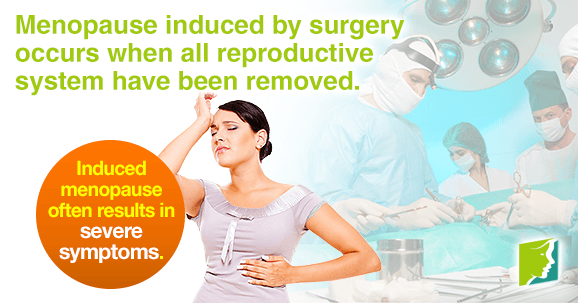
Menopause induced by surgery occurs when a woman must have part or all of her reproductive system removed. It can happen for various reasons. Endometriosis, for one, can be extremely painful and can be relieved through hysterectomy or oophorectomy. Both of these procedures are also often necessary in order to treat cancer, remove a large ovarian cyst, or to treat pelvic inflammatory disease (PID).
Why Are Surgically Induced Menopause Symptoms so Severe?
Induced menopause often results in harsher symptoms because of the abrupt cessation of the hormones produced in the reproductive system. Many hormones, like estrogen, are produced in the ovaries (though estrogen is also produced in the adrenal glands). With the sudden removal of the ovaries, the body is confused by the change in its customary level of estrogen. As a result of the unexpected hormone fluctuation, symptoms like vaginal dryness, hot flashes, and mood swings occur and are often more severe than if the body is given time to adjust to a gradual decrease of estrogen, as is the case with natural menopause.
More Information
If you are experiencing surgically induced menopause, it's important to talk about your symptoms with your doctor. They may be able to help you identify what's happening and provide some suggestions for relief. Also, learn how to prepare for surgical menopause or about the different treatment options for menopause symptoms.
Sources
- BMJ Group. "Menopause: What is it?" Patient Leaflet. 2007.
- Hopkins, Virginia. Lee, John R. M.D. What Your Doctor May Not Tell You About Menopause. New York: Warner Books Inc., 1996.
- Love, Susan M.D. Menopause and Hormone Book. New York: Three Rivers Press, 2003.
- Martin, Raquel. The Estrogen Alternative. Rochester, VT: Healing Arts Press, 2000.